
Manual › Your guide
Edible plants and recipes
What to harvest from a tree, shrub, herb or garden plant and when, storing and fermenting, saving recipes in your recipe book, sharing recipes with photos, stars and comments, importing recipes from a website or a file, and harvest times in your calendar.
Many trees, shrubs, herbs and garden plants give you something to eat, drink or make: elderflower syrup, lime-blossom tea, birch sap, blackberry jam, sloe liqueur, a spruce resin salve, wild garlic pesto, mint tea or crystallised violets. For each species, Bladwijzer tells you what to harvest and when, how to store it and what to watch out for, with recipes so you can get started straight away.
Edible and useful on the species page
The species page of about 100 species has an Edible and useful section:
- a month bar for each part (blossom, berries, leaves, sap…) showing the harvest months; the current month is circled;
- what to harvest from each part and how to pick it;
- Storing: drying, freezing, in jars or bottles;
- Fermenting, where possible: elderflower champagne, birch kvass, olives in brine…;
- Caution: poisonous parts, species that look similar, and places where you’d better not pick;
- recipes from Bladwijzer: each one opens on its own page.
If there’s something to harvest this month, Ready to harvest now appears at the top, and the species has an orange dot in the species list and in your guide.
Watch out
Only pick what you can identify with certainty. Don’t pick in nature reserves, along busy roads or next to sprayed fields, and leave plenty for the birds and insects. If in doubt, don’t eat it.
On garden plants
The page of about 145 garden plants from the catalogue also has an Edible and useful section, with the same month bar, storing, cautions and recipes: herbs (mint, marjoram, savory, borage, wild garlic, lemon verbena, chamomile, lesser calamint, cuckooflower, meadow clary…), edible flowers (violas, daisy, cowslip, daylily, saffron crocus, evening primrose, garden rose, common pink, large pink, musk mallow…), leaf vegetables (garden orache, amaranth, shungiku, bloody dock, bladder campion…), fruit (wild strawberry, loganberry, Cape gooseberry, feijoa, Japanese plum, chokeberry, red chokeberry, jujube, pomegranate, loquat, schisandra, crab apple, Siberian crab apple, Japanese apricot for umeshu and umeboshi, and lemon, lime, mandarin, kumquat, passion fruit and pineapple in a pot…), nuts and seeds (black walnut, yellowhorn, and water chestnut from your own pond), plants for tea or cordial (sweet woodruff, meadowsweet, bee balm, rosebay willowherb, lady’s bedstraw), sugar maple sap for maple syrup, herbs and spices from around the world (anise, black cumin, fenugreek, Vietnamese coriander…) and old medicinal herbs (hyssop, horehound, liquorice, marsh mallow, elecampane…), to be used in moderation: the warnings are under Caution.
- If a garden plant has the same harvest as a species in the guide (such as Ebbinge’s silverberry and oleaster, the wild thymes and common thyme, Oriental beech and beech, or red-leaved rose and dog rose), that’s stated with a link: the recipes are then those of that species.
- If a garden plant is poisonous, there are no recipes but a clear warning instead: what is poisonous, what it can be mistaken for and how to tell the difference (autumn crocus, lily of the valley and bluebells for wild garlic, daffodil and tulip bulbs for onions, bulbous irises for shallots, alocasia for taro, ornamental poppies for the opium poppy, autumn-flowering crocuses for saffron crocus, foxglove for comfrey, buckeyes for sweet chestnuts, savin for juniper, viper’s bugloss for borage), who is most at risk (children, dogs, cats, horses and livestock: lilies for cats, ornamental onions, cyclamen, kalanchoe and hosta for dogs and cats, houseplants of the arum family for cats, rhododendron and azalea for goats, sheep and rabbits, box clippings and fresh mowings with buttercups or delphinium for livestock, sago palm for dogs, silver ragwort, hemp agrimony and lantana for horses and livestock), what to do if the sap gets on your skin or in your eyes (spurge, burning bush, clematis, anemone and ranunculus, dieffenbachia, figs and poison primrose) and what to do if someone has eaten some. All poisonous garden plants, over 370 of them, have a warning of their own. You can’t link a recipe of your own to it either.
- A plant that’s edible for people but poisonous to pets (such as wild garlic and daylily) does have recipes, with that warning under Caution.
- A plant you use but don’t eat, such as southernwood (in sachets for the wardrobe), feverfew (in a vase), valerian (in a toy for your cat), lavandin (for lavender wands and bath salts) and French lavender (for sachets and pot-pourri; for cooking, use English lavender), has no Edible label and only recipes for using it, or none.
If such a plant grows in one of your gardens, its harvest times also appear in your calendar and on the map (filter Harvest now). You can link a recipe of your own to a garden plant: choose it under From which tree or plant?, in the Garden plants group. What isn’t there yet is on the list for later: new series will be added.
Good to know
What Bladwijzer says about edible and useful plants is general information, not medical or dietary advice. You eat, drink, pick and use plants at your own risk. Take extra care with allergies, pregnancy, medication, children and pets. We don’t check recipes you write yourself or import from a website. See the terms of use.
Your recipe book
In Recipes, search at the top by recipe, species or ingredient. Below are four parts:
- My recipe book: the recipes you’ve saved, written or imported. Filter on Own recipes, Shared, From Bladwijzer or From a website. There’s also a card to paste a link straight away, and a New recipe card.
- To make this month: what you harvest this month, with Bladwijzer’s recipes. What grows in your own gardens comes first, labelled From your garden.
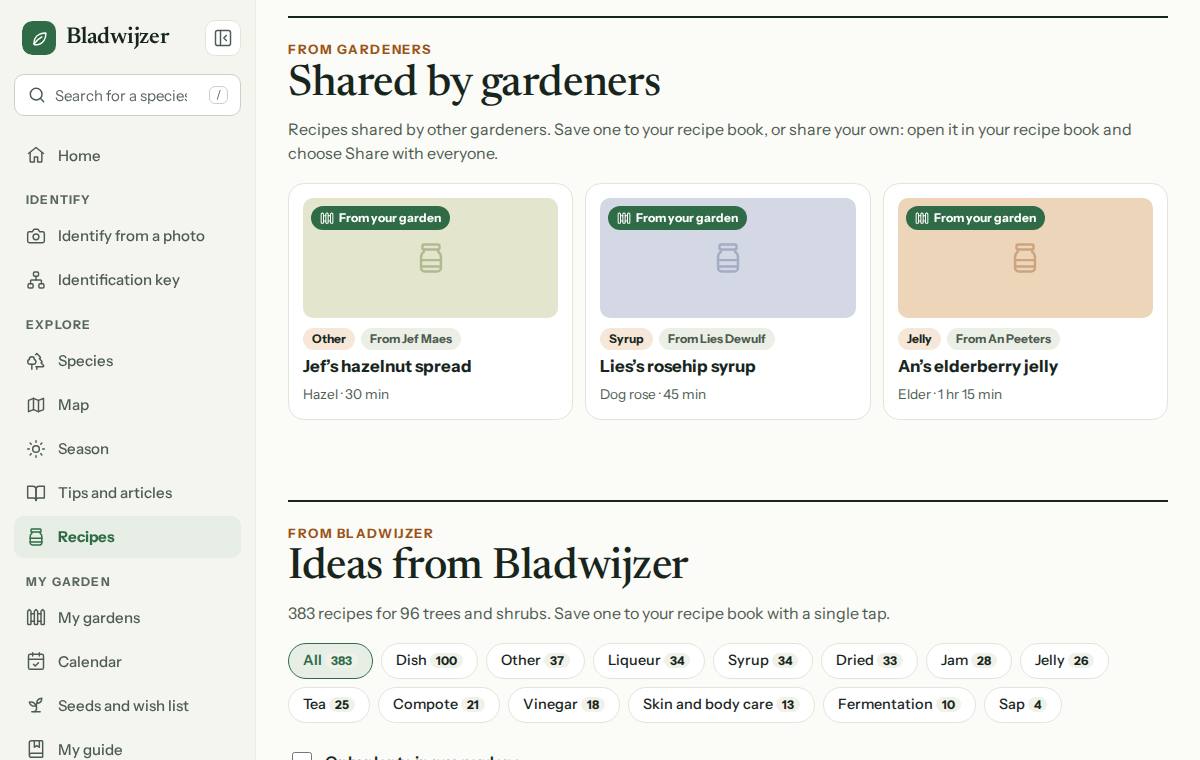
- Shared by gardeners: recipes that other gardeners shared, with their photo, the stars, who shared them, how often others made them too and how often they were saved. Choose Newest first or Top rated. The search at the top searches these too. See Sharing a recipe.
- Ideas from Bladwijzer: all of Bladwijzer’s recipes, by tree or shrub. Filter by type of recipe (jam, syrup, tea…) or on Only plants in my gardens.
Viewing a recipe
Every recipe from Bladwijzer has its own page, which you can also share. It shows a photo of the species, the yield, the time, the harvest months of the part the recipe uses (e.g. the blossom or the berries) and the tree or shrub, plus:
- 1×, 2× or 3×: the ingredient quantities scale along;
- a tick box per ingredient, to tick off what you have ready;
- the method in numbered steps, how to store it and what to watch out for;
- From your garden: which garden the species grows in and when you can harvest again;
- Stars: the recipe’s average rating, and your own stars;
- My notes: your own remarks, for example it was fine with less sugar too. Only you can see them;
- More to make with the same species.
To keep a recipe from Bladwijzer, choose Save to my recipe book (or the heart next to the recipe on the species page). You can then adapt it and add your notes. Every recipe has a Print and a Share button.
Writing your own recipe
- Choose New recipe under Recipes, or Add my own recipe on a species page (the tree is then already filled in).
- Give it a name, and choose the type of recipe and the tree or plant.
- Add up to 4 photos under Photos. The first one is shown at the top of the recipe and on its card in the list; tap a photo to see it full size.
- Put each ingredient and each step on its own line.
- Choose Save.
As long as you don’t share the recipe, only you can see the photos.
Sharing a recipe
You can share one of your own recipes (or a recipe from a file) with everyone:
- Open the recipe in your recipe book.
- Choose Share with everyone and confirm. You can also tick Share this recipe with everyone while writing or editing it.
After that:
- the recipe appears under Shared by gardeners and, if you chose a tree or shrub, on that species page too;
- it has its own page (See it as others see it) that you can pass on, and that search engines can find;
- everyone sees your name and your photos with it. My notes stay private;
- others can give it stars, comment and share a photo of their version, and it appears on the page with your recipes;
- anyone with an account can save it: that makes a copy in their own recipe book, with a link to your recipe. You can see how often it was saved.
If you edit the recipe later, others see the new version straight away (copies they already saved don’t change). Choose Shared with everyone again to stop sharing it.
You can’t share a recipe from a website: it belongs to its author. Pass on the link to the original instead.
Report: does a shared recipe not belong here, is it dangerous or is it not the sharer’s own? Choose Report on the recipe page. The administrator checks it and can hide it; the person who shared it then gets a notification.
Don’t want to see someone any more? Choose Block on the recipe or on a comment: you no longer see each other’s recipes, comments and photos, and that person can no longer comment on your recipes (see Blocking).
Stars
A shared recipe and every recipe from Bladwijzer show stars: the average (e.g. ★★★★☆ 4.3) and how many people rated it.
- When you’re logged in, tap 1 to 5 stars next to Give stars. You give one rating per recipe: tap a different number later to change it, or the same number again to remove it.
- You can’t give stars to your own recipe.
- Under Shared by gardeners, Top rated puts the recipes with the best stars first. A recipe with only one or two ratings doesn’t jump straight to the top: the more people rated it, the more their stars count.
Comments and “I made it too”
Below a shared recipe there are two parts:
- Made by others: photos from people who made the recipe too. Did you make it? Choose I made it too, add a photo of your version and, if you like, a short note (with half the sugar, and still delicious). You can do this once per recipe; delete your photo if you want to post a different one.
- Comments: a question, a tip or a thank-you, optionally with a photo. The person who shared the recipe can reply (labelled Shared the recipe).
The person who shared the recipe gets a notification for every new comment or photo; if they reply themselves, everyone who commented before gets a notification. Everyone who views the recipe sees your comment, your photo and your name. Delete your own comment or photo with Delete.
Does a comment not belong here (advertising, inappropriate)? Choose Report on the comment: the administrator checks it and can hide it. In its first few days, a new account can post at most five comments a day, without links.
A gardener’s recipes
On a shared recipe, tap the name of the person who shared it (or More recipes by …): you see all the recipes they shared, with the stars, the average across all those recipes, and how often others made and saved them. If that person also has a public guide, there’s a link to it, and their shared recipes are listed at the bottom of that guide.
Only what is shared and not hidden appears there. This page isn’t shown in search engines.
Importing a recipe from a website
- Choose From a website under Recipes.
- Paste the address of the recipe page and choose Import.
- Bladwijzer fetches the title, the ingredients, the steps, the time and how much it makes. Check everything, choose the tree or plant and save.
The recipe gets a link to the original, with the name of the website. We don’t copy the photos.
Most recipe websites include their recipes in the page in a fixed format (schema.org/Recipe, for search engines): that’s what we read. If we can’t find it, we save the title, the description and the link, and you fill in the rest yourself.
Good to know
Bladwijzer only fetches ordinary, public web pages (no addresses on your own network), and at most 30 an hour.
Importing and exporting
- Export: in your recipe book, Export downloads all your recipes as a JSON file. Your full export under Account includes your recipes too.
- From a file: choose a JSON file with recipes. That can be an export from Bladwijzer (from another account, for example), or a file of recipes in the schema.org/Recipe format, as some recipe apps produce. Up to 500 recipes per file.
Harvest times in your calendar
Harvest times appear in your pruning schedule, alongside the pruning jobs:
- for the plants in your gardens that you can harvest something from, including the garden plants from the catalogue;
- for the trees, shrubs and plants of the recipes in your recipe book, even if they’re not in your garden (you may pick them elsewhere).
If you’ve linked your schedule to Google Calendar, Apple Calendar or Outlook, they appear there automatically too, with a link to the tips and recipes. Things you can harvest all year round (such as pine needles) aren’t in the calendar.
Updated on 2026-10-10